Amused or Amazed?

Are you amused or are you amazed?

Amusement: An activity that is diverting and that holds the attention.  A pastime, play, game, anything which pleasantly diverts the attention.

Amazement: a feeling or sense of great surprise, awe, or wonder.

I was watching a “Christmas Special” movie with Caroline the other night.  It was a beautiful, western, country setting.  The fire crackling in the log home, yummy Christmas goodies, Christmas dinner with all the fixens, snow gently falling in the mountains, a huge Christmas tree with gifts. 

The movie also contained other scenes which included family arguments and dysfunction, a blizzard, an avalanche, a broken furnace, and emotional memories of missing family members.  The movie and acting were done well enough to hold our attention. 

However, unfortunately, this “Christmas Special” focused completely on the world, both its beauty and brokenness.  No hint of the ancient origins of this “holiday”, its original meaning and purpose, its spiritual impact, or how the One born that original day is personally involved in both the beauty and the brokenness in our world. 

It was a distracting amusement.  There was, sadly, no amazement.

The biblical account of the origins this celebration we call “Christmas” describes ordinary people who were not amused by what they had heard and seen but were truly amazed.  So amazed that they had to tell others.

When they had seen him, they spread the word concerning what had been told them about this child,  and all who heard it were amazed at what the shepherds said to them.  Luke 2:17,18

So…are you amused or are you amazed?  Perhaps, like me, you have taken the time to watch a Christmas Special Movie, but have you taken the time to read the historical, biblical account of the amazing birth of Jesus, the Savior of the world?  The movie will amuse, it will distract.  The biblical account will amaze.  Read Luke 2:1-20 to begin your amazing journey.

My Christmas prayer for you is that your celebration does contain some amusement, some distraction from the brokenness and worldly dysfunction.  I pray your celebration includes a warm, crackling fire in the fireplace, Christmas goodies, a beautiful tree with gifts, the love and warmth of family and friends.  I pray you are spared the blizzard, the avalanche, the difficult memories, the family arguments, and the broken furnace.

But do not let either the beauty or the brokenness of this world distract you from your ability to be amazed. 

Merry Christmas!  Be blessed!  Be in awe! Be amazed!

Mike

A Virus Free World

There is a “virus” that has infected many in our country and world.  It is more deadly and contagious than COVID-19.  This virus results in the disconnect condition of “Mental Myopia” in those who have been infected. It seems to have infected mostly big-city-dwellers, though not exclusively. 

This blinding virus prevents those infected from seeing the connection between a dead tree and the wood used to construct their high-rise apartment, mansion, and dining room table. They simply cannot understand the connection between sustainable forest management, which includes logging and loggers (real people and families).  To realize that logging and forest fuels management can be synonymous with caring for the Earth and can be a tool to prevent catastrophic forest fires is beyond them. 

They cannot see the connection between the metal in their fancy freezer/refrigerator and fancy car to the mining industry and the mining families.  They do not understand that the ice cream in their freezer has its origin in an animal called a cow.  They will eat it gleefully while condemning the farming/ranching industries for polluting the environment with bovine-produced methane.  

It prevents them from understanding the correlation between the food in the grocery store to the farm and the farming families who make their living outside of the big city and put food on their wood table.  

It prevents them from connecting the gas in their car and the heat from their furnace to a hard-working family in the fossil fuel industry. 

It blinds them to the truth that the little, unborn girl and boy in their mother’s womb also have individual bodies, are “persons”, and should not be sacrificed on the alter of “choice”.  The meanings and application of volition and personal responsibility are manipulated to justify murder by those infected with this virus.

This virus creates the illusion that bigger government, more bureaucratic regulation, and higher taxes results in greater freedom and prosperity.   This virus alters the mind to believe that government should not be the servant of the people but the caregiver of the people.  It prevents the ability of those who are infected to realize that every power-hungry autocrat and bureaucratic will, with a big smile, apply for the job to be their nanny and will promise Heaven on Earth, “If you give me the power”. Historian and moralist, Lord Acton (1834-1902) stated: “Power tends to corrupt, and absolute power corrupts absolutely.”  He applied this statement to mankind.  I think he was correct.

I must admit that I too, in many ways, have been infected by this virus.  This emotionally heightened and volatile political season (worldwide) will at times bring it out in me (see above).  I can demonstrate “blindness” and a callous attitude to certain situations and philosophies.  I can lack understanding and connectedness to others. I have the ability to be myopic.  It is the condition of fallen mankind of which I am a member.

 I am thankful there is a vaccine.  And I am confident it is not man-made government.

Jesus was recorded to have said: “Come to me, all you who are weary and burdened, and I will give you rest.  Take my yoke upon you and learn from me, for I am gentle and humble in heart, and you will find rest for your souls.  For my yoke is easy and my burden is light.”  Matthew 11:28-30

Amid all this worldly unrest, may we “come”. May we be encouraged as we look forward to His promised virus-free world.

Mike

Hugging Trees

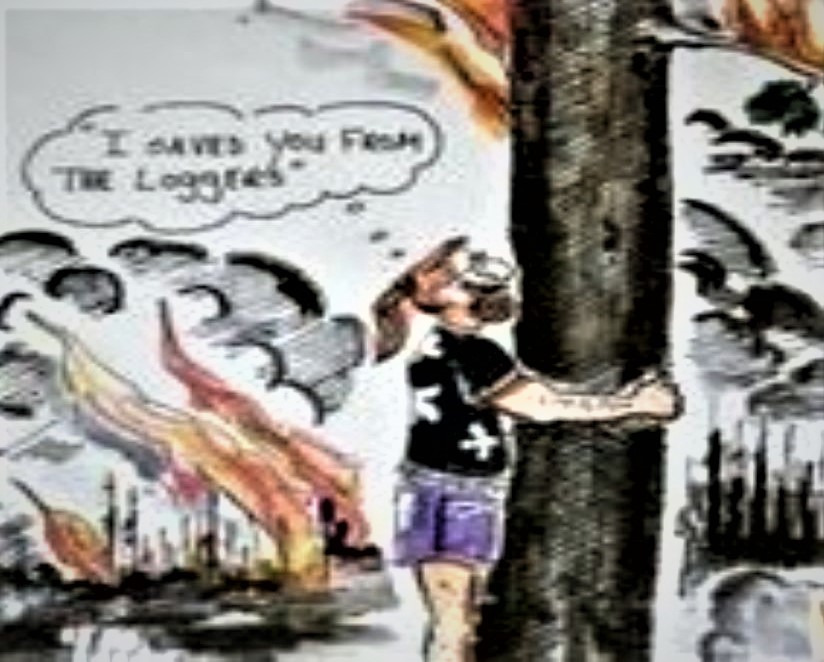
“I saved you from the Loggers” as the forest burns. Sorry for the poor image.

The anthropomorphic tears illustrated above express “personification” which is an innate and valuable characteristic of human beings. However, it is sadly and easily misplaced and misused resulting in destructive mismanagement of forest ecosystems. It can also result in dehumanizing those who advocate for conservation, which this illustration does. Conservation includes logging and other hands-on management strategies. A preservation mentality in a biological system simply results in a slower progression towards death filled with disease.

Entropy (deterioration, collapse, decay, decline), in our current “fallen” existence, is persistent and unyielding. Death, being the ultimate disorder or state of maximum entropy. Hugging a tree with your arms will not defeat the inevitable and may result in a diseased and unhealthy forest ecosystem. However, hugging a tree with a chainsaw may be the best way to ensure a healthy forest. This can include even and uneven-aged management strategies, depending upon the condition of the forest, along with fire management that does not look at every fire as an enemy to be suppressed.

There is room for both Wilderness areas and Multi-use-management areas in this philosophy. Homes and communities need to be protected. A natural legacy also needs to be protected. There are reasonable, established best-management practices for both. Let’s use them!

Mike

PS The Good News about death. It will be defeated!

“When the perishable puts on the imperishable, and the mortal puts on immortality, then shall come to pass the saying that is written: “Death is swallowed up in victory.” 1 Corinthians 15:54

“…and He will wipe away every tear from their eyes; and there will no longer be any death; there will no longer be any mourning, or crying, or pain; the first things have passed away.” Revelation 21:4

“He has put an end to death for ever; and the Lord God will take away all weeping; and he will put an end to the shame of his people in all the earth: for the Lord has said it.” Isaiah 25:8

A Great God…not a tame god

Photo by Alexas Fotos on Pexels.com

A spiritually bankrupt world in need of “a Great God”, a Good God…not a tame god!”

“Mark it down. God does not save us because of what we’ve done. Only a puny god could be bought with tithes. Only an egotistical god would be impressed with our pain. Only a temperamental god could be satisfied by sacrifices. Only a heartless god would sell salvation to the highest bidders. And only a great God does for his children what they can’t do for themselves.” written by Mac Lucado, “The Applause of Heaven”

Our Country, this world will continue to get crazier and more bankrupt until we all realize how “thirsty” we are; and realize the only waterwell in this desert with “Living Water”, the Water that can quench our spiritual thirst, is found in Jesus the Messiah (Yeshua HaMashiach).

He is not puny or egotistical. He does not enjoy our pain. Nor is He temperamental…but as C.S. Lewis said in “The Chronicles of Narnia”, He is not “safe”, in the sense that he is not tame, but “He is good”.

“Sir, give me this water so that I won’t get thirsty…”

See John 4:13-15; Revelation 21:6; Romans 10:9

Be encouraged today!

Mike

Forest Fires and Smokey the Bear

At the end of August 2020 there were at least 77 large complexes of wildfires burning in 15 states across the United States. Almost a third of them in California.

The many damaging forest fires around the U.S. are, in great part, the result of 75 years of Smokey the Bear, emotionally-driven forest management. Some have termed adherents to these forest management philosophies as “nature fakers”. It is a “hands-off” approach resulting in the suppression of naturally caused forest fires and the unnatural build up of forest debris, and fuels. In a season of high temperature, such as we are in now, the results can be devastating to the ecosystem, lives, and property.

Myopic, anthropomorphic forest management is not a good policy nor a strategy that benefits the forest ecosystem. Creating human-like characteristics or fictional personas in trees and other forest populations, such as Smokey the Bear, does not result in a healthy forest ecosystem. It only makes fire the enemy.

People, bears, deer, and other such critters are only a small part of a comprehensive forest management plan. There is as much “forest” below the soil as there is above. As a professional forester for over 20 years I wrote and executed management plans on large, private landholdings that were surrounded by State, Federal, Tribal, and other private lands. I can testify that it is a very complex process ecologically and relationally.

Should emotions have a role? Sure. They can give us a meaningful connection to other creatures, including trees. This empathy can be healthy and helps us care for other living creatures and systems. But creating a comprehensive management plan that places emotion in its proper, controllable and helpful position in the plan is necessary. When emotion is the overriding governing policy, the result in a natural ecosystem can be devastating.

Nobody likes to see living things die. However, in our current “fallen” ecosystem (world) death is a necessary part of life. Trees are biological systems with natural life and death stages, and cycles. Each stage, each completed cycle benefits a healthy forest ecosystem.

Best Management Practices are not myopic or overly emotional. Fire is a necessary part of a healthy ecosystem and can be productive, not damaging with proper management.

Time to put Smokey back in the forest where he belongs!

Mike

The Solution to all this chaos

Author Max Lucado wrote: “For all its peculiarities and unevenness, the Bible has a simple story. God made man . Man rejected God. God won’t give up until he wins him back.”

There it is! The solution to all this chaos.

Stop rejecting the call for a relationship with your Creator. I’m not suggesting a works-based religion, trying to earn His favor. That is not how He wants to win your heart. It is through a volitional choice on your part to engage in that relationship. And when you do, He will put His arms around you and say, “Bring all your stuff, your baggage, your hurt, your pain, your doubts, your questions. Move in, and we will work on all that together.”

“Come to me, all you who are weary and burdened and I will give you rest.” Jesus as recorded in Matthew 11:28

Today…be encouraged.

Mike

Note: God made “man” male and female. See Genesis 2:27

Abolishing Positive Commitment-Another plank in the counterculture platform

Abolishing Positive Commitment. Another battle in the culture war.

Commitment: The state or quality of being dedicated to a cause, activity: synonyms: dedication, devotion, allegiance, loyalty, faithfulness. Oxford dictionary.

The message on some billboards in WI and MN read: “Tired of poverty? Finish School, Take Any Job, Get Married, Save & Invest, Give Back To Your Neighborhood.” The billboard was created by the Center For Urban Renewal and Education in Washington DC. An organization founded by a black women named Star Parker, who stated:

“I lived criminal activity, drug activity, sexual activity. I barely graduated high school literate. I was in and out of the abortion clinic, after clinic. I lived on welfare.”

She said it was these five precepts that pulled her out of poverty. Apparently, many have stated that this message is sexist and racist, including many on the political far left and some of the leaders in the BLM (Black Lives Matter) organization who pressured the billboard owners to remove the message. One person was reported as stating: “To every woman, that’s damn near ‘keep her barefoot and pregnant,'”. Hmmm, I just don’t see that.

I see these precepts as encouraging positive commitment. Commitment to yourself, your employer and fellow workers, to a very special person & life-long relationship, to financial security and to selfless concern for others within your community. This is the foundation of “hope”…the ability to see yourself in a better place, a better way, a better situation in the future. The opposite of these precepts breeds “hopelessness”!

Look at the information below relating to worldwide poverty and the connection to education in the article, Understanding the Connection Between Education and Poverty Feb 07, 2020 – Globalcitizen:

“Nearly 60 million people could escape poverty if all adults had just two more years of schooling, and 420 million people could be lifted out of poverty if all adults completed secondary education, according to UNESCO. Education increases earnings by roughly 10% per each additional year of schooling.” The author asks: “Why does poverty stop girls from going to school?” “Poverty is the most important factor that determines whether or not a girl can access education, according to the World Bank. If families cannot afford the costs of school, they are more likely to send boys than girls. Around 15 million girls will never get the chance to attend school, compared to 10 million boys.”

It is clear that this research, which I believe could be applied to any nation, shows it is not finishing school, or simply a lack of education that will keep girls/women “barefoot and pregnant”. Educated parents can escape poverty and raise their children out of poverty. Their educated children can go on to raise their children out of poverty. Seems like a good plan to me. And these statistics, though related, do not address the positive impacts from the other four listed precepts on the billboard. All of them together are very powerful!

So…since when did positive commitment start to become negative? I’m not sure exactly; perhaps at the very first rebellion against God. However, it was predicted some 2000 years ago that the “last days” would show an increase: “But mark this: There will be terrible times in the last days. People will be lovers of themselves, lovers of money, boastful, proud, abusive, disobedient to their parents , ungrateful, unholy, without love, unforgiving, slanderous, without self-control, brutal, not lovers of the good, treacherous, rash, conceited, lovers of pleasure rather than lovers of God-having a form of godliness but denying its power. Have nothing to do with such people.” (2 Timothy 3:1-5) A stark warning!

Regardless of where we are in this time-line, the human characteristics listed in this Scripture are not positive and should be avoided. It is these that will keep women “barefoot and pregnant” and in poverty.

The Prophet Isaiah stated: “Woe to those who call evil good and good evil, who put darkness for light and light for darkness, who put bitter for sweet and sweet for bitter” Isaiah 5:20.

I think, as important and positive as these five precepts are, they are not complete. I would add two more: “Love the Lord your God with all your heart and with all your soul and with all your strength and with all your mind”. And, “Love your neighbor as yourself.” Jesus, as recorded in Luke 10:27.

I pray these billboards and this message are restored and lives are changed through positive commitment.

Mike

Statesman vs Politician An open letter to my son about a political agenda for power

An Open Letter to my Son, who is angry and questioning, rightfully so, why skin color and gender have played such a huge and dramatized role in Biden’s pick for VP.

Son ,I fully understand your anger and why you are asking this question. The answer is because “politics”, affairs of the cities, as it is currently practiced and applied by man (male and female) is a man-made system born out of self-centeredness. With “man” in power it is not altruistic.

From a biblical perspective, the prophet Samuel warned the people of Israel what lies in store for them if they have their wish granted that a king, political ruler, rule over them instead of God. The warning was that the king, political rulers, will take, take, take and tax, tax, tax. Not just a warning to Israel but to the world! Under the guise of altruism man-empowered politics is about power. And that is truly what a career politician like Biden wants. His choice of a woman of “color” has nothing to do, in my view, with equality for women or people of color. I believe, he believes, it was a strategic, political choice to gain power. Rather than do what a true Statesman would do, which would be to choose the most qualified person for VP regardless of gender or color, he bent his knee to the extreme elements of his political party. His agenda is power, not people. That is your answer.

I do fear for our country right now. I do also, however, believe our Constitutional Democratic Republic and Federalist Separation-of-Powers, which are unique in the political world, will sustain our God-given and Constitutionally guaranteed rights and privileges for a while yet. There is an interesting statement attributed to a Scotsman named Alexander Fraser Tytler. He said:”A democracy cannot exist as a permanent form of government. It can only exist until the majority discovers it can vote itself largess out of the public treasury. After that, the majority always votes for the candidate promising the most benefits with the result the democracy collapses because of the loose fiscal policy ensuing, always to be followed by a dictatorship, then a monarchy”.

I see this happening in our country right now! Just replacing one form of man-made system and human “king” for another; embracing power and self-centeredness. The anarchy, destruction, senseless murders and news accounts showing people looting are symptoms of an eroding culture that is embracing self over others’ and replacing God with idols. Our Constitutional Democratic Republic, “One Nation Under God” is in jeopardy! However, until the man-made systems are replaced by a God-made system we will continue with this upheaval and turmoil in our country and world. And, biblically, we are promised this will happen in God’s timing. Until then we must maintain a measured level of participation in our political system, recognizing the people in power are the people whom God allows to be in power, but knowing this system or those leaders are not where our true hope lies.

Trust in God during these difficult times; turn those within your sphere of influence towards Him. Channel your anger into a positive, others-centered focus. Pray…respond to others with whom you don’t agree; don’t just react in anger. All else is like chasing after the wind. You will never catch it.

I love you Son!

Dad

Private Ownership…

The thoughts of Dr. Wayne Grudem: (research professor of theology and biblical studies at Phoenix Seminary as quoted in the book,
“True Courage: Emboldened by God in a Disheartening World” by Steve Farrar).

“According to the teachings of the Bible, government should both document and protect the ownership of private property in a nation. The Bible regularly assumes and reinforces a system in which property belongs to individuals, not to the government or to society as a whole.”

My thoughts:
I believe Dr. Grudem is correct.  I also believe that with private ownership comes responsibility; to be a good steward, to share wisely and to not covet the private ownership of others.  I wish I was better at all three.

My hope and prayer, as we continue in this seasonal celebration of thankfulness, giving and receiving, is that we focus more upon that which Christ had and was willing to give away than upon that which we don’t have and want to get.

May your Christ-mas celebration be blessed.

Michael Rueffert

A Christian’s View of Discrimination, Prejudice, and Oppression

Where I come from “diversity” is a dirty word!

Lessons I have gleaned from Jesus, Oskar Schindler, The Ten Boom Family, Dietrich Bonhoeffer, Richard Mouw- Uncommon Decency, Martin Luther King, Jr, Malcolm X, Oscar Romero, Mother Teresa, Spencer Perkins and Chris Rice-More than Equals, St. Augustine  (See the short biographies at the end of this paper)

…to celebrate diversity meant to embrace falsehood and compromise truth…

Where I come from “diversity” is a dirty word.  It is synonymous with “liberal”, “immoral” and “unprincipled”.   It is almost always associated with the acceptance, embrace and celebration of “alternative” lifestyles.  And especially those considered immoral, such as homosexuality.  I had a similar view of diversity which I tried to temper with the “love-the-sinner, not-the-sin” attitude.  I definitely linked diversity with relativism believing that to celebrate diversity meant to embrace falsehood and compromise truth, which is the result of a lifestyle governed by relativism.  I have now discarded this contemporary stigma of diversity and view it much differently; separate from relativism.   There are absolutes in creation and I must be willing to recognize them.

I believe God created this world and everything in it (Genesis 1 & 2).  It only takes a very cursory look at scripture and the creation around us to realize that God created diversity and probably intended it not only for some practical purposes but also to enrich us and make this world more interesting; not to create enmity, prejudice and division. (“And God saw that it was good” (Genesis 1:10,12,18,21,25). God created a world of “difference”.   Man (both male and female “man”) has created, through his voluntary acceptance and embrace of sin (rebellion against the Creator), aberrations of that difference.  Man has taken much of Gods beauty and made it ugly. He has taken much of what God intended for good and used it for bad. “There is a way that seems right to a man, but in the end it leads to death” (Proverbs 14: 12). Therefore, much of what man does should not be embraced and definitely not celebrated!

To embrace the rebel, however, does not necessarily mean we embrace the rebellion.

Christ, through many examples, showed us that many sinners turned from their lives of sin because of His embrace.  And each one of us, if we have received Christ Jesus, is an example of a sinner turning from sin because of Christ’s ultimate example of embrace upon the cross of Calvary.  ” .. for all have sinned and fall short of the glory of God, and are justified freely by his grace through the redemption that came by Christ Jesus” (Romans 3:23,24).  This, from the one who was sinless, should be a reminder to us, of how to treat our fellow sinners.  “For Christ died for sins once for all, the righteous for the unrighteous, to bring you to God” (l Peter 3:18).   Our purpose should not be to self-righteously condemn other sinners, but to turn them to repentance, and be conduits for the Holy Spirit to bring them to God. “Repent, then, and turn to God, so that your sins may be wiped out … “ (Acts 3:19).

 However, our purpose should also not be to cover over sin by ignoring it, or by white-washing it. “For the time will come when men will not put up with sound doctrine. Instead, to suit their own desires, they will gather around them a great number of teachers to say what their itching ears want to hear. They will turn their ears away from the truth and turn aside to myths. But you, keep your head in all situations, endure hardship, do the work of the evangelist, discharge all the duties of your ministry” (2Tim. 4:3-5).

His goal was to free them from their sinful practices and draw them to God. 

Not judge them.

God is not soft on sin or sinners. He is our example, so, nor should we be soft on sin or sinners starting first with our own sin and then helping others with theirs.  “Do not judge, or you too will be judged.  For in the same way you judge others, you will be judged, and with the measure you use, it will be measured to you. Why do you look at the speck of sawdust in your brother’s eye and pay no attention to the plank in your own eye? How can you say to your brother, ‘Let me take the speck out of your eye, ‘when all the time there is a plank in your own eye?  You hypocrite, first take the plank out of your own eye, and then you will see clearly to remove the speck from your brother’s eye” (Matt. 7:1-5). Jesus, however, was not afraid to directly confront sin or sinners.  Especially when it came to religious leaders who were teaching falsehood (see Matt. 23:13-36, i.e. “Woe to you, teachers of the law and Pharisees, you hypocrites!”).   Those in Christian leadership positions today should take this very seriously!  “No many of you should presume to be teachers, my brothers, because you know that we who teach will be judged more strictly” (James 3: 1). I don’t think God will be pleased with those teachers today who teach political correctness over Biblical correctness.   Also, with compassion, love and truth, He confronted the Samaritan woman at the well (John 4:8-10) and the woman caught in adultery (John 8:1-11).  His goal was to free them from their sinful practices and draw them to God.  Not judge them.  “If anyone hears my words and does not keep them, I do not judge him; for I did not come to judge the world but to save the world.”  John 12:47

…”Diversity”, the dirty word…

Man has definitely taken diversity, turned it into a dirty word, and used it as an excuse for prejudice, discrimination, oppression and…political correctness.  All of which are sinful acts perpetrated by one man upon another.   It is mans’ natural tendency to review sinful actions and rate them based upon severity.  And this is somewhat justified in terms of earthly punishment because the resulting earthly repercussions of one sinful act may be more or less severe than another.  For example, a person stealing a dollar from their neighbor has much less severe earthly repercussions than someone murdering their neighbor.  But both are sin in the eyes of God and are examples of our sinful nature of living for self rather than for God and deserve the same eternal punishment.  The eternal consequences are the same.  “For the wages of sin is death, … “ (Romans 6:23).

But God is no respecter of persons; he does not discriminate in his judgments and neither should we. “If you really keep the royal law found in Scripture, ‘Love your neighbor as yourself, you are doing right. But if you show favoritism, you sin and are convicted by the law as lawbreakers. For whoever keeps the whole law and yet stumbles at just one point is guilty of breaking all of it. For he who said, ‘Do not commit adultery, , also said, ‘Do not murder. ‘ If you do not commit adultery but do commit murder, you have become a lawbreaker” (James 2:8-11).   The law is a measuring stick. ” … through the law we become conscious of sin” (Romans 3:20).   And God, through the Scriptures has revealed that for us to treat one-another with favoritism, whether dealing with male or female, black or white, Jew or Gentile, idolater or adulterer, thief or drunkard is prejudice and results in discrimination and oppression, and is a sin.  

…The “deceived” are not the enemy.  The “Deceiver” is the Enemy…

It is clear to me that, in Gods eyes, sin is sin. Our focus, as Christians, should not be on the sin but on the sinner, ourselves included, and helping them and ourselves to: ” ‘Love the Lord your God with all your heart and with all your soul and with all your mind’ This is the first and greatest commandment. And the second is like it: ‘Love your neighbor as yourself’ All the Law and the Prophets hang on these two commandments” (Matt. 22:37-40).  The “deceived” are not the enemy.  The “Deceiver” is the Enemy. 

However, let me clear, I do not believe that locking your doors at night to prevent the thief, the deceived, from entering your home and harming you or your family is sinful discrimination.  The world is full of people who want only to take without regard to the safety or the value of others’.   To reach out to someone in love is one thing and may extend to you opening your door to them.  However, to trust them requires a greater degree of knowledge, wisdom and discernment.  Blind-trust is not an extension of Christ-centered love.  God has given us a great deal of information as to His trust-worthiness and how valuable we are to Him.  He does not ask us for blind-trust.  Faith…yes.  Blind-trust…no.  And I do not believe He requires us to blindly trust others’ in order to extend Christ-centered love to them.  Can this be extended beyond personal application to community or national application?  Yes.

…Dehumanization…

I witnessed in the movie Schindler’s List one of the clear components of prejudice that contributes to discrimination and oppression – dehumanization.  I believe that along with the lack of a basic understanding and practice of morality in both personal and public relationships, the fervor of unbridled, blind, self-serving nationalism, combined with a dehumanization of the Jewish people, which began generations previous and was perpetuated through each generation, contributed greatly to the horrible oppression.  The German Commander, as portrayed, displayed a cursory knowledge of the Jews relating to their history and strong work ethic, with what appeared to me to be a kind of jealous fascination. He related how they, the Jews, came with nothing and became active, functioning, successful participants in every area of society. He seemed to have a warped sense of being a part of history- in- the-making by ridding his part of the world of the Jews.  A kind of fervent nationalist view of kicking out the invaders.  He believed they were successful not only because of industrious, hard work, but because they took opportunities away from non-Jews and he was going to be a part of taking back what really belonged to him and his kind.  His belief that the Jews were not human was implied by his indiscriminate, murderous actions.  This, however, was still not a clear implication of dehumanization. Someone could have a blatant disregard for life or living things in general.   He, however, revealed his beliefs by clearly stating that he did not regard his Jewish maid as a “person in the strictest sense”.   He had a warped fascination and lustful desire for this girl which confused him because he believed she was not human and he was.  His confusion exploded in anger and a transfer of responsibility for his own actions and feelings, from himself to her.  Dehumanization, a lack of moral standards and practices, blind nationalism, and choosing not to accept responsibility for ones’ own actions, or lack of action, all contributed to this horrible-episode in history.   This short drama had within it all the components of prejudice, leading to discrimination, leading to oppression.

Schindler, on the other hand, is an example of moving in the opposite direction.  His story is one of moving from an immoral, very selfish lifestyle which didn’t really regard anyone as human or nonhuman, at least on a conscious level, but as pawns to be used in the game of life which essentially consisted of pleasure, making money and building a reputation.   His transformation came not dramatically but incrementally. He slowly began to see the worth in the Jewish people not just as workers to make him money, but people, human beings with talents and emotions and innate worth. He truly liked and admired his accountant, who, I believe, was the bridge to his transformation.  He subtly revealed the humanity of the Jewish workers to Schindler, one at a time, which slowly sensitized Schindler to their plight. He, Schindler, began to see in each Jewish face the little child that he saw, helplessly, hopelessly, aimlessly wandering in the midst of deafening confusion.  He saw humanity in each face and became obsessed with saving one more, just one more.  His legacy became not as he predicted; Oscar Schindler, the man who came with nothing, built a successful business and left town with two trunks of money, but Oscar Schindler, the man who came with nothing, built a successful business, left , town with no money and saved hundreds of lives; a noble and lasting legacy.

Incarnational Leaders

Other real-life characters of whom I have read, who were subjected to the same conditions and choices as Schindler, include The Ten Boom family and Dietrich Bonhoeffer.  Both began this conflict with firm Christian foundations. They could see the conflict in its most basic terms of good vs. evil; humanity against inhumanity and dehumanization.  They knew where they stood.  There really was no choice to be made.  The very nature of the conflict made their decision “easy”.  They did not desire to die or give up their earthly possessions, but they were willing to if that was the price.  Their example was Jesus himself.  “The reason the Father loves me is that I lay down my life–only to take it up again. No one takes it from me, but I lay it down of my own accord” (John 10:17,18).  “Therefore, I urge you, brothers, in view of God’s mercy, to offer your bodies as living sacrifices, holy and pleasing to God–this is your spiritual act of worship. Do not conform any longer to the pattern of this world, but be transformed by the renewing of your mind. Then you will be able to test and approve what God’s will is–his good, pleasing and perfect will” (Romans 12:1,2).  Father Ten Boom boldly stated that there was a Higher Power he must follow and answer to.  He and his family knew, without a doubt, that there could be very serious negative consequences to their actions.  They knew that their lives and livelihoods were being put at risk. Bonhoeffer knew this also.  However, unlike many other members of Bonheoffer’s’ Confessional Church in Nazi Germany, Bonhoeffer and the Ten Booms were willing to courageously act upon their beliefs and principles even in the face of great danger.

Schindler, however, entered the same arena extolling the virtues of war as an entrepreneurial heaven. He faced soul-searching dilemmas as he dealt with life and death decisions for others, for himself and for his business.  His motives were self serving at first, and later became clearly oriented towards saving lives.  There were no indications that Schindler was religious at all until the end.  You could see a war waging within his soul.  His own prejudices appeared not to be motivated by race or religion or gender but by ones’ ability to be useful to him and to his business.  And while he probably would not have supported the “removal” of those deemed “non-essential” to society, he was more than willing to look the other way.  He did not want to take any personal responsibility for the actions of the Nazi party even though he was more than willing to identify with them to further his own personal agenda.  He was even ready to, and did, defend the murderous actions of the German soldiers as normal occurrences in war. This all changed when he began to see not just “units” of workers but real people, friends, who were being unfairly oppressed.  This transition fits well with the definition of prejudice:  “Favorable or unfavorable feelings against persons or things that are irrational, and not based on factual information or experience”.  As Schindler gained information about the Jewish people and experienced their pain and trauma, his prejudice was transformed to respect.  Their struggle became his struggle; a necessary characteristic of an incarnational leader.

Each of these people exhibited self-sacrificing leadership.  The struggle of the oppressed people around them became their struggle. Not because they were forced to, but because they chose to.  All could have looked the other way and human history would have treated them as nearly non-existent, like most of us.  Instead they became examples of righteousness in a very dark period of history. And in each of these examples, we, as students of history, should be able to find guiding lessons for application to our own lives. I submit two lessons, though I know there are many more:

  • Don’t judge a book by its cover.  

The righteousness and the face of God may be found in an old watch-makers family, or in a theologian, or in a German industrialist. This is a common theme found throughout the Scriptures.  God saw a king in a shepherd boy!  Also, those appearing to exhibit a Godly righteousness may not be righteous in God’s sight at all. “For I tell you that unless your righteousness surpasses that of the Pharisees and the teachers of the law, you will certainly not enter the kingdom of heaven “ (Matt.5:20).  This is apparently evidenced by the lack of protest by Bonheoffer’s Confessional Church and also the Ten Booms pastor who refused to help the Jewish baby.  And, those appearing to not exhibit a Godly righteousness (Schindler) may be chosen by God for a special purpose and time and may, because of their brokenness, be open vessels for His use. A Biblical example would be the story of Zacchaeus found in Luke 19. A wealthy tax collector who came face to face with Jesus, repented of his sins and made restitution to those whom he had cheated. The greatest history book of all has recorded his act of repentance for each of us to learn from. Be on guard against worldly, preconceived notions which block the view of God.

  • Blind, uncritical nationalism will, at some point, be at odds with God’s law.

All three of these examples, Bonhoeffer, Schindler, and the Ten Booms made a conscious choice to put people above nationalism.   All of these people believed that the evil that had a stranglehold on their nation would someday end, and that they had to be light within the darkness.  Bonhoeffer writes, ” …

Christians in Germany will face the terrible alternative of either willing the defeat of their nation in order that Christian civilization may survive, or willing the victory of their nation and thereby destroying our civilization.  I know which of these alternatives I must choose; but I cannot make this choice in security” (In a letter to Reinhold Niebuhr).

 Bonhoeffer left the security of the U.S. and returned to Germany where he preached and worked hard for the oppressed and was later imprisoned and put to death for his anti-nationalist stance.  Schindler, when confronted by his Jewish accountant with reports that the shell casings from his plant were inferior and unusable, and the military was rejecting them, made it very clear, secretly, that this plant was a place of refuge for the Jewish workers, not a munitions plant.  He stated that he would be very disappointed if a shell casing that could be used effectively by the German military were produced at his plant.  Clearly an anti-nationalist comment.  The Ten Booms actions of providing safe-haven for many Jews speaks for itself.  They had no loyalties for their German invaders, but they were clearly putting people above any nationalist interests.  Richard Mouw, in his book Uncommon Decency states, “To honor your nation–your ‘fatherland’ or ‘motherland ‘–is a legitimate thing. There can be something very noble and healthy about patriotic sentiments, just as there is something good about nurturing positive sentiments for our parents …. But from a Christian point of view the problem starts with the attitude itself, quite apart from any bad consequences that may flow from it. My nation does not deserve my uncritical loyalty.  No country should ever be encouraged actually to think of itself in the Best Nation terms.  Nationalism and superpatriotism are forms of idolatry. And the Bible makes it very clear that this is the kind of idolatrous attachment that Jesus wants to free us from.  Christians are being gathered into a new kind of community in which all the older allegiances of our present world begin to take second place: … “.

Just Law vs. Un-just Law

I agree with Mr. Mouw, however, I have to ask myself how this form of disobedience relates to the many passages of scripture which command “submission” to authorities and governments: “Everyone must submit himself to the governing authorities, for there is no authority except that which God has established” (Romans 13: 1).  “Submit yourselves for the Lord’s sake to every authority instituted among men: whether to the king, as the supreme authority, or to governors … ” (1 Peter 2: 13,14).  Could it be that the Ten Booms and Schindler and Bonhoeffer were all in opposition to God in their disobedience to the Nazi government?  Or was Martin Luther King, Jr. in opposition to God because of his non-violent civil disobedience?  Or those who are protesting, in a non-violent way, the killing of innocent unborn children?  I say “No”!

There is no doubt in my mind that God calls believers to love and help one another and be “holy”-“different”, in a positive way, from the rest of the world: “Religion that God our Father accepts as pure an faultless is this: to look after orphans and widows in their distress and to keep oneself from being polluted by the world” (James 1:27).   ” … ‘Administer true justice; show mercy and compassion to one another. Do not oppress the widow or the fatherless, the alien or the poor. In your hearts do not think evil of each other’ “(Zechariah 7:8-10).  And, it is also true that He calls governments, as an institution, and those serving in governments to truly serve and be just in their governing. 

 Allow me to complete the quote of 1Peter 2: 14: ” … who are sent by him to, punish those who do wrong, and to commend those who do right.”  This is a job description for governments and government officials. Nowhere in their job description does it say they have the authority to discriminate and oppress. If they are not following Gods command for their role or function, and creating laws which reflect this disobedience, then for one to peacefully disobey the edicts of a corrupt government or government official is, in my view, justified.

 Martin Luther King, Jr. in his “Letter from Birmingham Jail states:  “…I would be the first to advocate obeying just laws. One has not only a legal but a moral responsibility to obey just laws.  Conversely, one has a moral responsibility to disobey unjust laws.   I agree with St. Augustine that “an unjust law is no law at all”.  So, what is the difference between the two?  How does one determine whether a law is just or unjust?  A just law is a man-made code that squares with the moral law or the law of God.  An unjust law is a code that is out of harmony with the moral law.  This disobedience, however, I believe is different than non-submission to the institution of government.  God has instituted government as a practical means of organization and problem solving.  And believers should be submissive to the institution.  Anarchy is not an institution of God.  Individual governments and government officials who have taken on the role of oppressor have stepped outside the ‘job description’ given by God and are in a state of anarchy against God.  It is therefore Biblical, in my view, to submit to government as an institution of God, and to obey the edicts which are not in opposition to the higher law of God and disobey those which are in opposition.

Taxes and Murder

 Examples would be taxes and murder (murder as opposed to killing is a subject for another discussion).  To pay taxes to the government so that the institutions can function is both to submit and to obey justifiably.  “Give to Caesar what is Caesar’s and to God what is God’s” (Matt. 22:21, see also Romans 13:7).   “You shall not murder” Exodus 20:13.  To murder, or allow the murder of men, women and children (born or unborn), as many governments today allow, because of their inclusion in a category such as Jew, or Black, or Christian, or Muslim, or unborn, or old, because the government says it is lawful is not justifiable according to God’s higher law, and disobedience to mans’ law is justifiable.   However, as Martin Luther King, Jr. continues: “One who breaks an unjust law must do so openly, lovingly and with a willingness to accept the penalty.”  This would not constitute non-submission to government as an institution.   The authorities are “God’s servants”, they are not God!  They are not infallible.  This is not a high station of unbridled authority and power but a station of servant-hood and carries with it the mandate to be knowledgeable concerning the will of God and to administer justice according to His will.

Those reading this may say: “Taxes and murder are easy categories for which to judge just or unjust.  What about discrimination or prejudice or oppression of those within these categories?  What about unfair or oppressive taxes?  What about discrimination against someone of another faith?  What about the woman who is pregnant from a rapist?  Fair questions…and not always easy to answer.  I can only answer as a Christian that I must submit these types of situations to God and ask for clarity and wisdom as well as the ability to compassionately engage with those involved.  The Bible does not clearly delineate every situation we may face, but it does give us guiding principles.   “You shall  love  the  Lord  your God with all your heart and with all your soul and with all your strength and with all your mind, and your neighbor as yourself”  Luke 10:27.        Should I object to and perhaps fight against oppressive taxes or wasteful spending by my government?  Yes!  Should I voice my opposition to euthanasia of the old or infirm?  Yes!   Should I openly disagree with and fight again the murder of unborn children?  Yes! Should I use wisdom and discernment, which may be viewed by some as discrimination, prejudice or oppression, as to the extent that I will allow those of other ideologies into my life?  Yes.  All prayerfully.

God is not a pacifist

I also submit to you that to “submit” is different than to “obey”.  Our duty is not to blindly or uncritically be submissive to or obey every spirit or power or government or authority, but to: “Finally, be strong in the Lord and in his mighty power. Put on the full armor of God so that you can take your stand against the devil’s schemes. For our struggle is not against flesh and blood, but against the rulers, against the authorities, against the powers of this dark world and against the spiritual forces of evil in the heavenly realms” (Ephesians 6: 10-12).  In this way, the sovereignty and power of God is revealed to mankind, as God uses those who remain steadfast in his service, and also uses the forces of darkness to work His will.  Some rulers, authorities and powers of this world allow themselves to be used as forces of darkness.  To obey these authorities would be to obey Satan (the Deceiver) and to disobey God.  And God, I believe, is no pacifist!  There is evidence that He has used both spiritual and physical forces to fulfill His will.  In doing so, throughout history, He has called upon men and women to put on the “full armor of God”, first, and then the armor-of-man to battle “against the powers of this dark world and against the spiritual forces of evil in the heavenly realms” and defeat those who promote discrimination, prejudice and oppression.

 At times I shake my head in disbelief when I learn about both the contemporary and historical atrocities of man against man.  I ask myself, “How can people treat other people like that?  What would I do if I were there at that time in that situation?”   I have asked myself those questions concerning the crucifixion of Jesus too.  The only honest answer I can give is that I don’t know for sure.   I feel confident, in retrospect, that I would not be the one “pull the trigger” to kill a Jew in Germany or physically drive the spikes.  But the truth is that if the authorities said they would kill my family if I did not obey…???  And, it is my sin that crucified Jesus.  No, I was not there.  But every time I sin I drive the nail deeper into His flesh.

What really haunts me is the possibility of being one of those who turned or turns away, ignoring the evil because it didn’t or doesn’t  affect me or mine in a personal or substantial way.  That really scares me because I know what my Lord thinks about those who are lukewarm: ” .. .I am about to spit you out of my mouth” (Rev. 3:16).  What evils, within my sphere- of- influence, am I ignoring today?  What evils am I lukewarm about today?  I have not only learned about Malcolm X and Romero but I have also lived them in the sense that I am alive during the same period they lived.  This gives me a sense of interest that is somewhat different than with situations that occurred before I was alive, such as the Holocaust.  Kind of like the interest I would have in a relative who died before I was born as opposed to one whom I personally knew or know well.   Interest in historical events is somewhat different than interest in contemporary events.  The important question of “what would I have done”, relative to history, is within the realm of speculation and can be easily manipulated.  One is forced to leave speculation behind when confronting contemporary events, and the important question then becomes “what am I doing now?”.  

Incarnational Leadership

All of the people I have mentioned above appear to have the same answer to this question. Their answer is not so much in their words as it is in their actions. All, I believe, would say,” be an incarnational leader.”  For the Christians among them, the scripture “Do not merely listen to the word, and so deceive yourselves. Do what it says” (James 1:22) would hold practical meaning.  They would not just be words to them, but truly an admonition from God for their personal application. The non-Christian, Malcolm X, I think would agree, however, he would probably not see it as an admonition for his own personal application, but as a message that white people need to apply.  And he would be somewhat justified.  A lot of injustice was perpetrated upon him and his family by misguided, hypocritical, white Christians.  But seeing the faults of others and just telling them they need to change, or separating yourself from them, will not necessarily make them modify their behavior.  The incarnational leader must model the desired behavior.  Jesus, Mother Teresa, Perkins and Rice, Dietrich Bonhoeffer, Martin Luther King, The Ten Boom family and others modeled what they preached.  Yet there were differences in their approaches.  I have tried to figure out why some of them were martyred for their beliefs and activities, and others not.  Did the ones who were killed fail in some way?  Did they do something wrong and the others something right?  Or, is martyrdom an indication that they did it right, and those not martyred did something wrong? 

Perkins and Rice, had they lived and proposed their ideas in the late 1800’s or early 1900’s may have been martyred for their activities.   Mother Teresa, had she confronted the powers that be in a more threatening way may have been martyred.  Yet she was very effective in serving the poor and oppressed without being threatening.  If Romero had not personally and overtly opposed the terrorists and ordered them to stop, but had simply and quietly supported the poor and oppressed as Mother Teresa did, would he have lived and been more effective?  If Jesus had not confronted the religious leaders with their hypocrisy, would he have lived?  My conclusion is that it was more a circumstance relating to the time and place and perhaps even more importantly, their calling from God.  Each of these servants of God were operating in prayer, seeking God’s will and responding as He lead, even unto death.  It is not my place to ask if one went too far or not far enough.  My place is to look at the face in the mirror and ask if I am responding as God leads me in the face of the prejudice and oppression occurring within my area of influence and in my own time.

What is a Christian to do?

What should the church do today? I believe, as Perkins and Rice and Bonhoeffer clearly state that the only effective and lasting solution is found in Christianity.  “and it was Dietrich Bonhoeffer who more than anybody else realized that nothing less than a return to the Christian faith could save Germany.”

 (Memoir of Dietrich Bonhoeffer by G. Leibolz).   Perkins and Rice in their book More Than Equals state we may actually be “feeding the insatiable beast of racism” through government programs, and money and studies.  “Is it possible that our countless attacks against racism actually reinforce its will to exist and even enable it to grow stronger? There is a high degree of relativity involved in even determining what is truly racist. The inability to arrive at an objective standard with which to judge the actions of others has left us in a racial tailspin that can only be overcome by a definitive approach rooted in objective truth, coupled with a tenacious commitment to pay whatever price is necessary to follow Jesus down the road to reconciliation.”   They continue, ” … It is this reality that makes Christianity uniquely able to address the crisis of racism in America. We have objective truth. And so we can judge inappropriate action immediately while we take whatever time necessary to massage the heart and bring the emotions and actions in line with the truth.”   

This is Christian Incarnational Leadership.   Believing that within Christ and the Christian message of the Gospel is the answer to the problems of prejudice, and then, taking the time, making the commitment, accepting the sacrifice needed to become intimately involved in bringing the message to those who need the message of the heart.  And in bringing that truth we may find that the hidden dark places in our own hearts will be revealed and the truths of God will be made clear to us.

Slavery of blacks, as practiced in America, and the residual discrimination and prejudice of post-slavery America was no less insidious and cruel than that which was perpetrated against the Jews by the Nazis. As I learned about Jews being shot and imprisoned in Germany I could just as easily envision blacks being hanged and imprisoned in America.   As I learned about German children exhibiting hatred toward Jews that they had learned from their parents’ examples, I could envision white American children exhibiting hatred towards black Americans.  And as long as prejudice is individually tolerated by Christians today, within their own spheres- of- influence, the roles could very easily be reversed at some other point in history!  And I say “individually tolerated by Christians within their own spheres- of- influence” because therein, I believe, lies the answer–with individual Christians, where they are…today!  A 2014 study by the Pew Research Center, as reported by CBS News, states that “…Christians continue to be the world’s most oppressed religious group, with persecution against them reported in 110 countries .   

 See http://www.pewforum.org/2014/01/14/religious-hostilities-reach-six-year-high/

It is very easy for us to look at the problems of prejudice, discrimination and oppression and feel overwhelmed.  We watch the news broadcasts and read the paper and shake our heads, much like I did when watching these movies or reading these books, and think how horrible things were or are.  We feel great emotion, and feelings of being overwhelmed, and the belief that the problems are too big for one person to do anything about.  These feelings over-take us and we use the size of the problems to justify inaction.  We turn off the news broadcast, throwaway the paper, finish the movie and then go on with our daily activities, much like the smoker who was becoming depressed because every time he read the newspaper he saw an article about the dangers of smoking, so he canceled his subscription to the newspaper.  Many of us see the problem as so big, and too costly that we ignore personal responsibility within our own sphere-of- influence and the potential to make a difference because we think we are too small and the problems are too big.

Christian church leaders must strongly encourage individual Christians in their personal lives not to bow down to the idols of prejudice, discrimination, oppression or relativism.  Christ is our model?  The scriptures are full of examples of Christ boldly breaking down walls and barriers between races, rich and poor, male and female, Jew and Gentile. He did it in prayer, where he was, and in following the call of his Father in Heaven. We must do the same, in prayer, in our homes, work places, schools and churches. Martin Luther King, Jr. pointed out in his “Letter from Birmingham Jail”, a statement from Reinhold Niebuhr that “groups tend to be more immoral than individuals.”  We, as moral Christian individuals, must extend this consciousness of morality to other individuals and the groups within our influence.

In conclusion, I think there is a point of application to be made concerning the similarities I have noticed between the “just-war doctrine” discussed by Richard J. Mouw in his book Uncommon Decency and the four basic steps in any nonviolent campaign discussed by Martin Luther King, Jr. in his Letter from Birmingham Jail.  I believe that these principles can be very useful tools for any Christians today who are concerned about the potential costs, benefits, and appropriateness of becoming involved in issues relating to discrimination, prejudice, and oppression.  Examples would be church racial segregation and denominational segregation, the abortion issues, age related issues involving both young and old such as gang related violence, parental dysfunction, euthanasia, radical and violent ideologies and many others. These principles will help those who want to begin the process of extending this “consciousness of morality” to their friends, neighbors, congregations, prayer or Bible study groups, youth groups, etc.

The Just War Doctrine asks these questions:

 -Is my cause a just one?

-Am I sustained in my commitments by the wisdom of competent authorities?

-Are my motives proper?

-Is my move beyond mere civility a choice of last resort?

-Is success likely?

-Are the means I am employing proportionate to the good goals I want to promote?

See: http://www.vernalproject.org/papers/understanding/JustWarCriteria.pdf  for more detailed information.


And Martin Luther King Jr., from the Birmingham jail, stated: “In any nonviolent campaign there are four basic steps:

-collection of the facts to determine whether injustices exist;

-negotiation;

-self-purification;

-direct action.”

I would add that any Christian who is considering a course of action, first, bathe it in prayer, and justify it with a thorough Biblical exegesis.

“Rejoice in hope, be patient in tribulation, be constant in prayer.” Romans 12:12

“ Do your best to present yourself to God as one approved, a worker who has no need to be ashamed, rightly handling the word of truth.  But avoid irreverent babble, for it will lead people into more and more ungodliness,  and their talk will spread like gangrene.”  2 Timothy 2:15-17

 “All Scripture is breathed out by God and profitable for teaching, for reproof, for correction, and for training in righteousness,  that the man of God[b]may be complete, equipped for every good work.”   2 Timothy 3;16,17

“…but test everything; hold fast what is good.”  1 Thessalonians 5:21

Jesus said,  “… In this world you will have trouble. But take heart! I have overcome the world” (John 16:33).  It truly is in the sacrificial example of Jesus that we can find the faith, the knowledge, the courage, the justification and the heart to boldly face the evils and challenges of discrimination, prejudice and oppression within our own areas of influence, and, within the world.

Mike

Short Biographical information of referenced people and authors

Jesus: Jesus (God saves) Christ (Anointed One-chosen by God) was born circa 4-6 B.C. in Bethlehem; died circa 30 A.D.  Little is known about his early life, but his life and his ministry are recorded in the New Testament, more a theological document than a biography. According to Christians, Jesus is considered the incarnation of God and his teachings are followed as an example for living a more spiritual life. Christians believe he died for the sins of all people and rose from the dead. 

“Here is a man who was born in an obscure village, the child of a peasant woman. He grew up in another village. He worked in a carpenter shop until He was thirty. Then for three years He was an itinerant preacher.

He never owned a home. He never wrote a book. He never held an office. He never had a family. He never went to college. He never put His foot inside a big city. He never traveled two hundred miles from the place He was born. He never did one of the things that usually accompany greatness. He had no credentials but Himself.”

https://www.gotquestions.org/real-historical-Jesus.html


 Oskar Schindler: Oskar Schindler (28 April 1908 – 9 October 1974) was a German industrialistspy, and member of the Nazi Party who is credited with saving the lives of 1,200 Jews during the Holocaust by employing them in his enamelware and ammunitions factories.  https://en.wikipedia.org/wiki/Oskar_Schindler

The Ten Boom Family:  During World War II, the Ten Booms lived out their Christian faith by making their home a refuge–a hiding place–for Jews and members of the Dutch underground who were being hunted by the Nazis.  Four ten Booms gave their lives for this family’s commitment, but Corrie came home from the death camp. She realized her life was a gift from God, and she needed to share what she and Betsie had learned in Ravensbruck: “There is no pit so deep that God’s love is not deeper still,” and “God will give us the love to be able to forgive our enemies.”  At age 53, Corrie began a worldwide ministry that took her into more than 60 countries in the next 32 years! She testified to God’s love and encouraged all she met with the message that “Jesus is Victor.”  http://tenboom.org/aboutthetenboomsc48.html

 Dietrich Bonhoeffer:  Dietrich Bonhoeffer  (4 February 1906 – 9 April 1945) was a German Lutheran pastor, theologian, anti-Nazi dissident, and key founding member of the Confessing Church. His writings on Christianity’s role in the secular world have become widely influential, and his book The Cost of Discipleship has become a modern classic.

Apart from his theological writings, Bonhoeffer was known for his staunch resistance to Nazi dictatorship, including vocal opposition to Hitler’s euthanasia program and genocidal persecution of the Jews. He was arrested in April 1943 by the Gestapo and imprisoned at Tegel prison for one and a half years. Later he was transferred to a Nazi concentration camp. After being associated with the plot to assassinate Adolf Hitler, he was quickly tried, along with other accused plotters, including former members of the Abwehr (the German Military Intelligence Office), and then executed by hanging on 9 April 1945 as the Nazi regime was collapsing.  https://en.wikipedia.org/wiki/Dietrich_Bonhoeffer

 Richard MouwUncommon Decency:  Richard John Mouw (born April 22, 1940) is an American theologian and philosopher. He held the position of President at Fuller Theological Seminary for 20 years (1993–2013), and continues to hold the post of Professor of Faith and Public Life.   https://en.wikipedia.org/wiki/Richard_Mouw

Martin Luther King, Jr:  Martin Luther King Jr. (born Michael King Jr., January 15, 1929 – April 4, 1968) was an American Baptist minister and activist who was a leader in the Civil Rights Movement. He is best known for his role in the advancement of civil rights using nonviolent civil disobedience based on his Christian beliefs.    https://en.wikipedia.org/wiki/Martin_Luther_King_Jr.

 Malcolm X:  Malcolm X (/ˈmælkəm ˈɛks/; May 19, 1925 – February 21, 1965), born Malcolm Little and later also known as el-Hajj Malik el-Shabazz[A][pronunciation?] (Arabic: الحاجّ مالك الشباز‎‎), was an African-American Muslim minister and human rights activist. To his admirers he was a courageous advocate for the rights of blacks, a man who indicted white America in the harshest terms for its crimes against black Americans; detractors accused him of preaching racism and violence. He has been called one of the greatest and most influential African Americans in history.

Malcolm X was effectively orphaned early in life. His father was killed when he was six and his mother was placed in a mental hospital when he was thirteen, after which he lived in a series of foster homes. In 1946, at age 20, he went to prison for larceny and breaking and entering. While in prison, Malcolm X became a member of the Nation of Islam, and after his parole in 1952, quickly rose to become one of the organization’s most influential leaders. He served as the public face of the controversial group for a dozen years. In his autobiography, Malcolm X wrote proudly of some of the social achievements the Nation made while he was a member, particularly its free drug rehabilitation program. The Nation promoted black supremacy, advocated the separation of black and white Americans, and rejected the civil rights movement for its emphasis on integration.

By March 1964, Malcolm X had grown disillusioned with the Nation of Islam and its leader Elijah Muhammad. Expressing many regrets about his time with them, which he had come to regard as largely wasted, he embraced Sunni Islam. After a period of travel in Africa and the Middle East, which included completing the Hajj, he repudiated the Nation of Islam, disavowed racism and founded Muslim Mosque, Inc. and the Organization of Afro-American Unity. He continued to emphasize Pan-Africanism, black self-determination, and black self-defense.  In February 1965, he was assassinated by three members of the Nation of Islam. https://en.wikipedia.org/wiki/Malcolm_X

 Oscar Romero: Óscar Arnulfo Romero y Galdámez (15 August 1917 – 24 March 1980) was a prelate of the Catholic Church in El Salvador, who served as the fourth Archbishop of San Salvador. He spoke out against poverty, social injustice, assassinations and torture. In 1980, Romero was assassinated while offering Mass in the chapel of the Hospital of Divine Providence. https://en.wikipedia.org/wiki/%C3%93scar_Romero

 Mother Teresa:  Mother Teresa MC, known in the Catholic Church as Saint Teresa of Calcutta[6] (born Anjezë Gonxhe Bojaxhiu; Albanian: [aˈɲɛzə ˈɡɔndʒɛ bɔjaˈdʒiu]; 26 August 1910 – 5 September 1997), was an AlbanianIndian[2]Roman Catholic nun and missionary. She was born in Skopje (now the capital of the Republic of Macedonia), then part of the Kosovo Vilayet of the Ottoman Empire. After living in Macedonia for eighteen years she moved to Ireland and then to India, where she lived for most of her life.

In 1950 Teresa founded the Missionaries of Charity, a Roman Catholic religious congregation which had over 4,500 sisters and was active in 133 countries in 2012. The congregation manages homes for people dying of HIV/AIDS, leprosy and tuberculosissoup kitchens; dispensaries and mobile clinics; children’s- and family-counseling  programmes; orphanages, and schools. Members, who take vows of chastity, poverty, and obedience, also profess a fourth vow: to give “wholehearted free service to the poorest of the poor”.      https://en.wikipedia.org/wiki/Mother_Teresa

 Spencer Perkins and Chris RiceMore than Equals:   When Spencer Perkins was sixteen years old, he visited his bloodied and swollen father (pastor John Perkins) in jail. Police had beaten the black activist severely, and Spencer never forgot the moment. He couldn’t imagine living in community with a white person after that. But his plans were changed.    Chris Rice grew up in very different circumstances, of “Vermont Yankee stock,” attending an elite Eastern college and looking forward to a career in law and government. But his plans were changed. Spencer and Chris became not only friends, but yokefellows—partners for more than a decade in the difficult ministry of racial reconciliation. From their own hard-won experience, they show that there is hope for our frightening race problem, that whites and African-Americans can live together in peace.  https://www.christianbook.com/more-than-equals-racial-healing/spencer-perkins/9780830822560/pd/1318

 St. Augustine:  Augustine of Hippo (/ɔːˈɡʌstᵻn/; 13 November 354 – 28 August 430) was an early Christian theologian and philosopher[2] whose writings influenced the development of Western Christianity and Western philosophy. He was the bishop of Hippo Regius (within modern-day AnnabaAlgeria), located in Numidia (Roman province of Africa). Augustine is viewed as one of the most important Church Fathers in Western Christianity for his writings in the Patristic Era. Among his most important works are The City of God and Confessions.

According to his contemporary, Jerome, Augustine “established anew the ancient Faith.  In his early years, he was heavily influenced by Manichaeism and afterward by the neo-Platonism of Plotinus. After his baptism and conversion to Christianity in 386, Augustine developed his own approach to philosophy and theology, accommodating a variety of methods and perspectives. Believing that the grace of Christ was indispensable to human freedom, he helped formulate the doctrine of original sin and made seminal contributions to the development of just war theory. When the Western Roman Empire began to disintegrate, Augustine developed the concept of the Church as a spiritual City of God, distinct from the material Earthly City. His thoughts profoundly influenced the medieval worldview. The segment of the Church that adhered to the concept of the Trinity as defined by the Council of Nicaea and the Council of Constantinople closely identified with Augustine’s On the Trinityhttps://en.wikipedia.org/wiki/Augustine_of_Hippo